
Pennsylvania Gov. Josh Shapiro on Tuesday unveiled a $53.3 billion budget proposal for Fiscal Year 2026-27 that relies on taking $4.6 billion out of the state’s Rainy Day Fund for emergencies and on revenues that may not materialize.
The budget plan represents an increase of $2.72 billion, or 5.4%, over the current fiscal year. Shapiro’s budget proposal includes approximately $2 billion in revenues from taxing skill games and legalizing recreational marijuana – initiatives that previously died in the state Legislature.
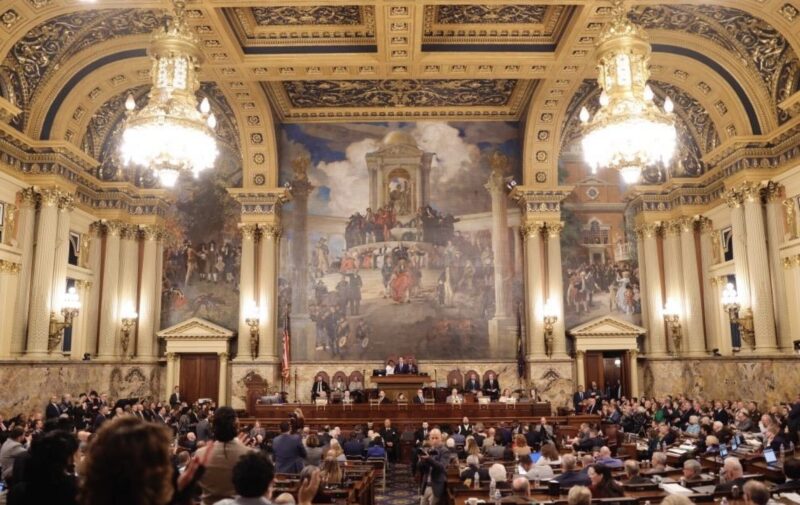
The Democratic governor told the General Assembly during his budget address that he has made historic investments in education, strengthened public safety, and driven economic development that has created over 21,500 good-paying jobs and attracted more than $39 billion in private-sector investment across the Commonwealth.
“This budget builds on the progress we’ve made by making smart, responsible investments that strengthen our schools, keep communities safe, and grow our economy,” Shapiro said.
But Republican lawmakers and financial experts issued warnings that massive tax increases could be on the horizon if the government keeps spending billions of dollars a year more than it is bringing in.
“Governor Shapiro’s budget proposal once again worsens our deficit and threatens Pennsylvania families with massive tax hikes,” said Nathan Benefield, Chief Policy Officer for the Commonwealth Foundation. “His proposal is unaffordable in every sense of the word—not only does he severely inflate revenue projections, but he proposes illegally tapping the state’s Rainy Day Fund to cover a $6.5 billion gap in spending and revenue.”
According to the Independent Fiscal Office’s most recent five-year economic and budget outlook, the Commonwealth is projected to face an operating deficit of $4.8 billion in FY 2025-26, growing to an estimated $6.65 billion in FY 2029-30.
“Governor Josh Shapiro may not believe in Pennsylvania’s fiscal reality of structural deficits, unfavorable demographics, a depleted surplus, and limited revenue, but that reality is not going away,” the Pennsylvania Manufacturers’ Association (PMA) wrote in a bulletin on Tuesday.
“Pennsylvania’s current fiscal situation calls for spending restraint, doing more with dollars already being spent, and a systematic review to eliminate fraud, duplication, and any other excesses that can be found,” said David N. Taylor, President & CEO of the PMA.
Some provisions of the budget plan drew bipartisan support, such as investments in career and technical education (CTE) and workforce development programs.
Over the last three years, the Commonwealth has increased funding for those types of programs by nearly 50 percent and Shapiro said the 2026–27 budget continues building on those investments. An additional $18 million would be invested in vo-tech, CTE, and apprenticeship programs, supporting STEM and computer science education, and expanding Schools-to-Work pathways to $7 million, doubling funding for career development programs that bridge the gap between school and employment.
“The governor’s address was a positive first step in the budget process,” said State Rep. Rob Matzie (D-Armbridge), chairman of the House Majority Caucus. “The proposed budget plan would deliver needed investments to our public schools, our workforce, and initiatives to make life more affordable for Beaver County residents – all without adding any new taxes.”
The budget plan also invests in life sciences, robotics, technology, energy, manufacturing, and agriculture, and introduces Innovate in PA 2.0. That $100 million program, funded through Insurance Premium Tax Credits, will expand venture capital access, strengthen leadership pipelines in life sciences and biotech, support clinical trials, commercialize university research, and seed regional venture studios.
State Rep. Martin Causer (R-Cameron/McKean/Potter) emphasized that Pennsylvania’s budget needs to focus on growth and economic development.
“We took steps in that direction with passage of the current year’s plan, which implemented some permitting reforms and removed the state from the Regional Greenhouse Gas Initiative to help encourage investment in our energy sector. Now, we need to continue that work to unleash the full potential of our energy industry to create quality job opportunities and meet growing needs for power here and in our surrounding states.”
Noting that Pennsylvania is the nation’s second-largest energy producer, the Pennsylvania Independent Oil and Gas Association (PIOGA) continued to urge the governor and the General Assembly to ensure that reliable, safe, and clean natural gas remains at the forefront of the “all of the above” energy portfolio.
“Unfortunately, the Governor’s address was strong on energy rhetoric but not on practical solutions. Price caps do not create electrons, and we need energy and environmental programs that encourage investment in Pennsylvania’s natural resources and lower system-wide demand. If the Governor wants more generation faster, he cannot punish Pennsylvania’s innovators that are going to produce that power,” PIOGA said in a statement.
The budget plan also proposes several tax credit modifications, including converting the Local Resource Manufacturing Tax Credit Program to a Reliable Energy Investment Tax Credit, allowing recipients to utilize up to $100 million per year tax credit per facility for three years, focusing on bringing new, reliable energy sources onto the grid. In addition, the Semiconductor Manufacturing Tax Credit Program would be updated by reducing investment requirement from $200 million to $150 million and lowering the permanent jobs requirement from 800 to 100.
The budget also makes new investments in critical infrastructure. Shapiro called for creating the Pennsylvania Program for Critical Infrastructure Investment, a $1 billion initiative supported through the issuance of general obligation bonds, with proceeds deposited into the Capital Facilities Fund. That program would provide funding for major infrastructure projects across the Commonwealth, including bringing new energy generation onto the grid, building and preserving housing, and upgrading school and municipal facilities.
The budget plan continues to decrease taxes for Pennsylvania businesses. Corporate Net Income Tax rate reductions would continue as scheduled under current law, which decline by 0.5 percent every year until the rate reaches 4.99 percent in tax year 2031.
The governor’s budget proposes eliminating a tax loophole that allows some large multi-state corporations to skirt paying their taxes in Pennsylvania — often known as the “Delaware Loophole.” The Delaware Loophole allows large businesses that have subsidiaries and related companies in other states to shift their Pennsylvania-based income to out-of-state subsidiaries, often in Delaware. That greatly reduces the Pennsylvania income and associated tax owed by their companies operating in Pennsylvania.
The governor’s plan states that closing the Delaware Loophole would realize billions in savings. But critics have said it would make Pennsylvania less business-friendly.
Shapiro has included in his budget plan a proposal for mandatory unitary combined reporting (MUCR) for corporate taxes. MUCR would require multi-state businesses to combine the income of related entities into a single tax return for Pennsylvania purposes.
“Proponents frame it as closing loopholes, but in practice it dramatically increases compliance burdens, reduces predictability, and makes Pennsylvania a less attractive place for companies that operate across state lines,” according to PMA.
Over the next several weeks, House and Senate Appropriations committees will hold hearings with state agencies to consider the details of the governor’s proposal and craft a final spending plan. Democrats hold a narrow majority in the House, and Republicans control the Senate.
Pennsylvania’s 2026-27 fiscal year starts July 1.