
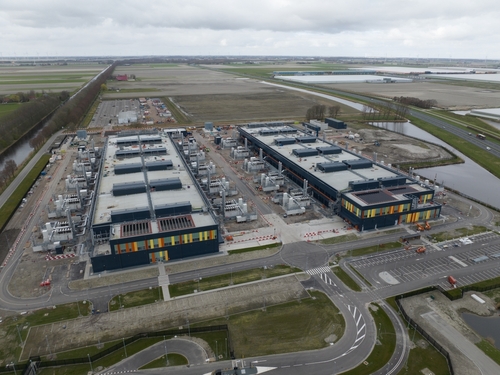
Members of the State Senate Majority Policy Committee on Aug. 11 reviewed the potential impacts of data center development in the commonwealth on communities and the economy.
“I have heard from many residents who felt they lacked clear information about data centers and their potential impact on our community,” said Pennsylvania Sen. Rosemary Brown (R-40) on Monday. “I requested this hearing to ensure that reliable, factual information was accessible to our community.”
The public hearing, hosted in Archbald, Pa., by Brown and Pennsylvania Sen. Dave Argall (R-29), gathered economic development organizations, utilities, environmental commissions, municipal associations, and other stakeholders to discuss the benefits and drawbacks of establishing data centers in Pennsylvania.
“We all have many questions about the rapid increase of data centers, as we saw today when more than 300 people attended our public hearing and hundreds more watched online,” Argall said after the hearing. “Why are so many new centers needed? Why locate in Pennsylvania? How could this affect my neighborhood? Our goal today was to answer as many of these questions as we possibly could.”
One panel focused on two of the widely cited concerns with operating data centers – the demands on local electrical grids and watersheds.
Christine Martin, president of PPL Electric Utilities, said that summer peak energy demand will double in five to six years due to the growth of data centers.
“In practical terms, we are doubling the energy demand that took more than 100 years to reach,” said Martin, noting that infrastructure improvements and legislative changes to maximize the efficiency of the transmission grid are key to ensuring universally reliable electricity.
Martin also said that PPL customers may see decreased transmission costs because of new large-load customers.
Andrew Dehoff, executive director for the Susquehanna River Basin Commission, discussed the potential challenges data centers pose to the water supply.
“One of the most critical aspects of data center development, the dramatic demand for water, is often left out of the conversation despite water being our most basic human need,” Dehoff said. “That may be because many data centers have existed in Pennsylvania for years without the need for very much water, or very much power for that matter.
“It is the newest generation of data centers — often called hyperscale data centers that are designed to handle massive amounts of data with growing demands of cloud computing for things like artificial intelligence and cryptocurrency — that are proving to require larger amounts of power and an associated high demand for water,” he added.
Dehoff said that state regulations exist so that all users of the basin’s water resources have reliable, conflict-free, and sustainable water supply for current and future generations, even as demographic, economic, and climate conditions evolve.
“We believe we have the necessary technology, knowledge and structure in place to incorporate hyperscale data centers into the mix in the same fashion,” he said.
Another panel featured employers and economic development organizations, such as the Pennsylvania Chamber of Business and Industry, which said Pennsylvania is well-positioned to host new data centers.
“With our unmatched energy resources, reliable water supply, industrial and digital infrastructure, workforce potential and strategic geographic location, we have all the ingredients to become a national, and even global, leader in data center investment and AI-driven innovation,” said Neal Lesher, the chamber’s director of government affairs.
John L. Augustine III, president and CEO of Penn’s Northeast, expanded on why northeast Pennsylvania could host data centers: “location, location, location.”
“Recently, a proposed 750,000-square-foot data center in York County is expected to amount to a $500 million project and bring with it more than $6 million to the local economy,” Augustine explained. “Tax revenue for Fairview Township would increase from $396 to $396,000 for the property; revenue for the fire department would increase from $52 to $52,000; revenue for York County would increase from $1,560 to $1,565,070, and revenue for the West Shore School District would increase from $4,054 to $4,066,415.”
Amazon Web Services (AWS), the cloud computing arm of Amazon, announced plans in June to invest $20 billion and create at least 1,250 new jobs in Pennsylvania.
“Our investment in the commonwealth isn’t just financial, it’s also in the people and future of Pennsylvania,” said Merle Madrid, senior manager of public policy for AWS. “Our June announcement included our commitment to partner with Pennsylvania educational institutions and workforce organizations to develop training programs that prepare job seekers for careers in data center construction and operations.”
This training and support, Madrid said, will include facilities and equipment donations to empower hands-on learning, faculty training from industry subject matter experts, and curricular content to link programs of study to industry standards and best practices.
“To support their plans, AWS is investing in energy capacity and workforce development programs,” he said. “Amazon made a commitment to be water positive, which means returning more water than they use to the communities where they operate.”
The final two panels focused on the potential positive and negative impacts data centers could have on nearby communities.
“Data centers represent a unique proposition from a local land use perspective,” said Esch McCombie, co-chair of McNees Wallace & Nurick’s Real Estate Group. “They are low-traffic, high-value assets that generate substantial tax revenue for school districts, municipalities, and counties without the strain of increased commuter traffic, truck traffic, or new student enrollments.”
McCombie also noted that many of the concerns with these centers can be addressed through strategic planning and engineering.
“Some communities are also seeking to directly engage developers for Community Benefit Agreements,” added Kristopher Gaszi, assistant director and counsel for the Pennsylvania Local Government Commission. “These contract documents are often utilized to mitigate impacts from other forms of industrial development like energy generation facilities and are now being explored for data center projects.”
John Yudichak, president of Luzerne County Community College, provided an update on the Pennsylvania Commission for Community Colleges’ work to prepare for the workforce needs that come with new data centers.
“To meet the demands of data center development in Pennsylvania, community colleges are collaborating and combining resources like never before to build a new and historic Technology and Trades Workforce Consortium,” he said.